Showing posts with label ...rookie solo card. Show all posts

Saturday, April 24, 2021

Steve Renko (#87)

Today we look at Steve Renko's rookie card. 
 
Renko was signed by the Mets in July 1965, but did not play that summer. He also only played one game in 1966. 
 
After 2 full seasons on the Mets' farm, he began the 1969 season with the Mets' AAA team, but was sent to the Expos in the June 15th trade that brought Donn Clendenon to New York. (The Expos also received 3rd baseman Kevin Collins and 2 minor-leaguers.)
Steve made his major-league debut 12 days later. From that point until the end of the 1975 season he was a regular in the Expos’ starting rotation, twice winning 15 games (quite an accomplishment for a perennially bad team) along with 13 and 12-win seasons. His only bad year was 1972, when he posted a 1-10 record in 30 games (only 12 starts). 
 
Renko saw little action at the start of 1976, and was traded to the Cubs in May. After spending the first 7-plus seasons with the Expos, he bounced around for the 2nd half of his career. A year with the Cubs, then half a season with the White Sox. 
 
He was granted free agency after 1977, then spent 1 season with the Athletics and 2 each with the Red Sox and Angels, before wrapping up his career with the Royals in 1983. 
 

Saturday, October 17, 2020

Pedro Borbon (#358)

Pedro Borbon was a mainstay in the Big Red Machine’s bullpen from 1972-77, and led the team in saves in ’73, ’74, and ’77. Borbon pitched in 593 games in his 12-year career, starting only 4 games. He pitched in more games from 1970-78 than any other NL pitcher. This is his rookie card. 

Pedro was signed by the Cardinals in late 1964, but did not start playing until 1966. After 3 seasons with 3 different class-A teams, he was selected by the Angels in the Rule 5 draft in December 1968. 

Borbon played one full season (1969) with the Angels, pitching 41 innings over 22 games, then was traded to the Reds in the off-season (with pitcher Jim McGlothlin) for outfielder Alex Johnson and infielder Chico Ruiz.

He played most of 1970 and 1971 in the minors, only pitching 12 times for the Reds in the first half of 1970, and 3 games in September 1971. 

Pedro made the Reds on a full-time basis in 1972, and was 2nd to Clay Carroll in games and saves. In 1973 he posted a career-high 11 wins, while leading the staff in games and tied with Carroll with 14 saves. In 1974 he led the bullpen in games and innings pitched, and again collected 14 saves. 

For the next 2 seasons, Borbon maintained his high games and innings workload, although newcomers Rawly Eastwick and Will McEnaney picked up most of the saves. 

With McEnaney traded before the season, and Eastwick traded in mid-season, Pedro was the team’s top reliever in 1977. 

In 1978 he had a reduced role in the bullpen, although he posted an 8-2 record. In 1979 it was Borbon’s turn to go – traded to the Giants in June for outfielder Hector Cruz. 

He played for the Giants for the rest of that season, then was released just before the start of the 1980 season.  Pedro hooked on with the Cardinals at the end of Aptil, but after 10 appearances he was released at the end of May. 

Borbon appeared in 20 post-season games for the Reds from 1972-76, picking up 3 saves. 

Pedro was inducted into the Reds’ Hall of Fame in 2010. He passed away in 2012 at age 65. 

His son Pedro Jr. pitched for the Braves, Blue Jays, and others from 1992-2003.  


"Pinch hitting for Pedro Borbon… Manny Mota…Mota...Mota"

Wednesday, March 25, 2020

Angel Bravo (#283)

Angel Bravo is the oldest living player (with a card in the 1966-70 sets) that I have not yet featured on a blog.

He had a very brief major-league career with the White Sox (1969), Reds (1970-71), and Padres (1971).

He was signed by the White Sox in 1963, and played in the minors every season from 1963 to 1972, except for the 1970 season. He also played in the Mexican League from 1973-76, and the Inter-American League in 1979.

After 3 seasons in class-A ball, he advanced to AA in 1966. He played at the AA and AAA levels in '67 and '68. In 1969 he led the Pacific Coast League with a .342 batting average.


Angel made his major-league debut with the White Sox in June 1969, and started 2 dozen games in center field, mostly in late-June and mid-September. After the season he was traded to the Reds for pitcher Gerry Arrigo.

Bravo spent the entire 1970 season on the Reds' roster (his only season not in the minors). The Reds lineup being what it was, Bravo rarely got any playing time, starting only 6 games in center field (to Bobby Tolan's 146 starts), and was the team's 8th outfielder (behind even Johnny Bench and Jimmy Stewart). Although only playing parts of 22 games in the field, he did get into 43 other games as a pinch-hitter.

In mid-May 1971 he was traded to the Padres for OF Al Ferrara. Once again he was mostly a pinch-hitter, since the Padres had Cito Gaston and Ollie Brown as everyday outfielders, along with Larry Stahl, Leron Lee, and Ivan Murrell all sharing left field. Bravo’s last major-league games came in September 1971.

He played all of 1972 for San Diego's AAA team in Hawaii, then played in Mexico for 4 seasons. In 1979 he played 15 games in the ill-fated Inter-American League before it folded.

---

The Inter-American League lasted only 3 months in 1979. It planned to play 130 games, but 2 teams (Panama and Puerto Rico) dropped out in mid-June. Two weeks later the league folded.

The standings at that time were:
1. Miami (72 games played)
2. Caracas (64)
3. Santo Domingo (67)
4. Maricaibo (67)
5. Panama (51)
6. Puerto Rico (55)

Saturday, September 21, 2019

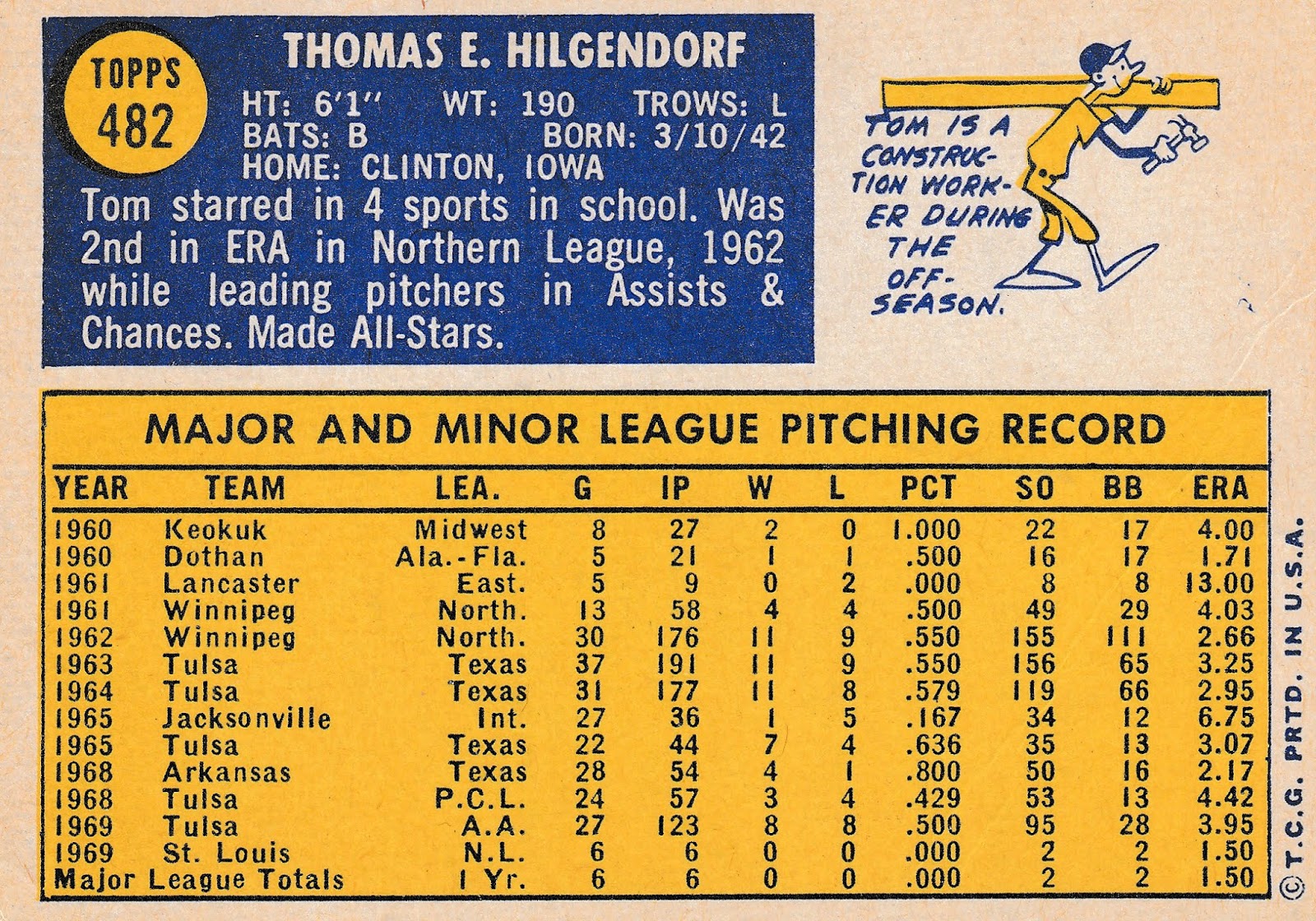
Tom Hilgendorf (#482)

This is Tom Hilgendorf's rookie card. On the back, it shows that he made his major-league debut in 1969, pitching only 6 games (and 6 INNINGS!) To which I say "Why does he have a card?" Surely he only rates half of a Cardinals Rookie Stars card?

I'm also labeling this post as "new to me", because back in the day I only collected cards from 1967-69, and also in 1972. Either he wasn't in the 1972 set, or I wasn't paying attention to relievers on teams I didn't follow. So I was not aware of Tom for many years. I got this card just a few years ago as I was building the 1970 set prior to starting this blog.

Truth be told, my first awareness of him was when I got his 1976 Phillies card sometime in the 1980s, while I was completing my 1964-present run of Phillies cards. Still, although I followed the Phillies closely from 1967 to the mid-1980s, I have absolutely no recollection of him pitching 53 games for Philly in 1975. (Surprising, because I DO remember many forgettable appearances by Phillies' relievers Mike Wallace, Dave Wallace, Ron DiOrio, Frank Linzy, John Montague, Ed Farmer (in his 1st go-round), Jesus Hernaiz, Pete Richert, and George Culver.)


Anyway, Tom began his career in the Cardinals' organization way back in 1960. After 6 seasons on the farm, he missed the '66 and '67 seasons.

Hilgendorf returned to the Cards' organization in 1968 and made his major-league debut in August 1969. In both 1969 and 1970, he played for the Cardinals and for their AAA team.

After the 1970 season, he was traded to the Royals but played all of 1971 in the minors.

Tom began the '72 season in the minors but was traded to the Indians in mid-June. He pitched 19 games for the Tribe in the second half. From 1973 to 1975 he managed to stay out of the minor leagues. Tom was the Indians' top man in the bullpen in 1973, leading the relievers in innings pitched and saves (6). In '74 he dropped to the #4 reliever slot.

During spring training in 1975, he was traded to the Phillies for a minor-leaguer and spent his final MLB season pitching 96 innings (all in relief) slotted behind Tug McGraw and Gene Garber.

The Phillies released him the following April, and although he was picked up by the Pirates, he played the 1976 season in triple-A before retiring.

Monday, October 23, 2017

Tom Timmermann (#554)

Here is Tom Timmermann’s rookie card. As I have mentioned previously, I didn’t collect 1970 or 1971 cards back in the day, so I first heard of Tom when I got his 1972 card.

As with Paul Doyle’s card (2 posts ago),  I probably would not have blogged about Timmermann had he not appeared on my “Oldest living players not blogged yet” list.

Timmermann was signed by the Tigers in 1960, and it took him 9 ½ long years to work his way up to the Tigers, debuting in mid-June 1969.


Tom pitched for the Tigers from 1969-73, mostly as a reliever. He led the team with 27 saves in 1970, but also started 25 games in 1972 and 16 in 1973.

In mid-June 1973 he was dealt to the Indians for pitcher Ed Farmer. Tom started 15 of his 29 games with the Tribe over the remainder of the season.

1974 was Timmermann’s final season. He appeared in 4 games for Cleveland (the last on April 26th), then spent the rest of the season in the minors before retiring.

Hey! I found the perfect battery-mate for Timmermann:

Thursday, September 21, 2017

Paul Doyle (#277)

Here is Paul Doyle's rookie card. Doyle only had one other Topps card, found in the 1972 set.

I have no recollection of Paul from back in the day, and would probably have skipped blogging about him altogether, had he not appeared high on my "Oldest living players from 1966-1970 not blogged yet" list.

As a kid, I only collected cards from 1967-69 and 1972, and only got his 1970 card a few years ago. I DID have his 1972 card that year (having collected all the '72 cards in 1972 except for Bill Russell) but he was a virtual unknown then. (That he played for an American League team 3000 miles from Philadelphia didn’t help him enter my card-collecting consciousness.)


Doyle was signed by the Tigers in 1959, and languished in the minors for 9 seasons (hitting the Tigers', Yankees', Giants', Astros', and Braves' organizations) before making his MLB debut with the Braves in May 1969. Although primarily a starting pitcher in the minors, he was strictly a reliever in his 87 career major-league games.

He pitched in 36 games in his rookie season, then was sold to the Angels in late-November.

In 1970 he appeared in 40 games out of the Halos’ bullpen, then was sold to the Padres in late-August 1970. He only pitched 7 innings over 9 games with San Diego in the season's final weeks, and spent all of 1971 in the minors.

Reacquired by the Angels prior to the 1972 season, Paul appeared in 2 games over the first month, and that was it for his career. He didn't play in the minors during 1972, so it is unclear if he was released in early-May, or missed the remainder of 1972 due to injury.

Tuesday, January 3, 2017

Rickey Clark (#586)

Rickey Clark was a teammate of previous blog subject Marty Pattin with the 1968 Angels. Despite Clark's contributions to the 1967 Angels, this is his first Topps card.

Clark was signed by the Tigers in 1965, and after 2 seasons in the minors, he was selected by the Angels in the Rule 5 draft. This means automatically making the team the following season. Not only did he make the team in '67, he was their #3 starter as a 21-year-old rookie, compiling a 12-11 record in 32 games (30 starts).


Unfortunately, his first season was his best season. In 1968 he crashed and burned with a record of 1-11 in 21 games, only pitching half the innings he did as a rookie. Clark spent most of 1969 and all of 1970 in the minors.

He returned to the Angels for part of 1971 (11 games over the 2nd half of the season). His final big-league season was 1972, appearing in 26 games for the Angels, while staying out of the minors for the first time since 1968.

The Phillies purchased his contract in January 1973, and he played 29 games for their AAA team before retiring.

Monday, December 12, 2016

John McNamara (#706)

Here is Athletics’ rookie manager John McNamara, sporting the white cap that the coaching staff always wore.

This was McNamara’s first full season as a major-league manager, and the Athletics’ 3rd manager in the three years since they moved to Oakland in 1968!

John never played major-league ball, but was a minor-league catcher for the Cardinals, Giants, and Phillies from 1951 to 1957, save for missing 1953-54 while in military service.

In 1958 he joined the Athletics’ organization, and was a player-manager from 1959 to 1966 (although he played very little after 1963). He also pitched in 14 games between 1960 and 1963.


McNamara was a major-league coach for the A's in '68 and '69, then took over the reins for the last 13 games on the ’69 season after Hank Bauer was fired.

He only lasted one full season in Oakland. After an 89-73 record, he was replaced by Dick Williams, who led the team to three straight post-season appearances, including World Championships in ’72 and ’73. (In 1974, Al Dark returned to the A’s (having managed them in ’66 and ’67) and added a third consecutive World Championship that season.)

John also managed the Padres (1974-77), Reds (1979-82), Angels (1983-84), Red Sox (1985-88), Indians (1990-91), and back with the Angels as an interim manager for 28 games in August 1996.

His teams made the post-season twice: The Reds won the NL West in 1979, and the Red Sox won the AL pennant in 1986.

Saturday, December 26, 2015

Jose Martinez (#8)

This is Jose Martinez’ rookie card. Having not collected baseball cards in 1970, I first became aware of Martinez while he was a first-base coach. If I recall correctly, it was for the Kansas City Royals, in the 1980 World Series against the Phillies.

It’s not surprising that he slipped through the cracks back then, because he only had a 2-year career (1969-70). Martinez was signed by the Pirates in 1960, and worked his way up the ladder, playing in triple-A in ’65 and ’66. After missing the 1967 season, he found himself back in double-A in 1968.


Jose made his major-league debut in April 1969. That season, he played in 42 games as a utility infielder, and started 35 games at 2nd base (mostly during June and July).

Martinez began the 1970 season with the Bucs, but after only 19 appearances (mostly pinch-hitting or pinch-running), he was sent down in late-May, never to return to the show. He remained with the Pirates’ AAA team through the end of the 1971 season.

Jose was sold to the Royals in March 1972, and played 3 seasons with their AAA club in Omaha, Nebraska, then was released in April 1975. He also pitched 4 innings in 1974.

After his playing career, Martinez worked for the Royals as a minor-league manager and major-league coach from 1980-88, then coached with the Cubs from 1988-1994. In 1995 he began working in the Braves’ front office as a special assistant to the GM, where he remained until his death in 2014.

Saturday, October 10, 2015

Chuck Taylor (#119)

This post is about Chuck Taylor, not Chuck Taylors, But as long as I have your attention, behold the Holy Grail of sneakers from back in the day:

We always referred to these as "Converse All-Stars", not "Chuck Taylors" or "Chucks" as is done these days. I also recall that all the "cool kids" had these as early as elementary school, while the rest of us didn't catch up until jr. high (having been saddled with "sensible" sneakers like Keds or PF Flyers prior to that). The other thing I remember is that the only style that "mattered" was black hi-tops. Having white Converse sneex, or black low-tops just wasn't the same.


Oh yes, Chuck Taylor:

This is Chuck Taylor's rookie card, the first of his 6 consecutive cards.  He pitched for 8 seasons (1969-76), mostly for the Cardinals and Expos. Although he started half his games as a rookie, he was a reliever for the rest of his career.

Taylor was signed by the Cardinals in 1961, and pitched 8 seasons in the minors before making his MLB debut with the Cardinals in May 1969.

Prior to the 1964 season, he was traded to the Houston Colt .45s (with outfielder Jim Beauchamp) for outfielder Carl Warwick. Midway through the following season, Houston returned him to the Cardinals (with pitcher Hal Woodeshick) for pitchers Mike Cuellar and Ron Taylor.


After a few games in AAA in 1969, Taylor was called up to St. Louis in late May. After spending 2 months in the bullpen, he joined the rotation and made 12 consecutive starts from late-July to the end of the season. Chuck appeared in 56 games in 1970 – all in relief except for 7 starts in June and July. He also led the team with 8 (!) saves that season.

During the 1971/72 off-season, he was part of a 4-for-4 trade with the Mets that included Beauchamp going to New York, and Jim Bibby and Art Shamsky going to St. Louis. Taylor split his time in 1972 between the Mets, their AAA club, and the Brewers.

The Brewers released him in spring training 1973, but he was quickly snapped up by the Expos. Chuck pitched for Montreal for 3 full seasons and part of 1976, also playing for the Expos’ AAA team for part of 1976.  He retired after the season.

Thursday, June 12, 2014

Ike Brown (#152)

Here is Ike Brown’s rookie card. He also appeared in the 1971 to 1974 sets.

One thing that I learned about Ike a few years ago while researching somebody for these blogs (maybe Elston Howard or Ernie Banks) was that Ike Brown also played in the Negro Leagues. This surprised me, because although I had his 1972 card back in the day, I knew he wasn’t in the 1967 to 1969 Topps sets, so I assumed he would have been too young.

Brown is the last player from the Negro Leagues to have made it to the major leagues. To recap, in addition to the well-known alumni to have played in the majors in the 1960s (Willie Mays, Hank Aaron, Ernie Banks, Elston Howard, Minnie Minoso), others were Junior Gilliam, George Altman, John Wyatt, Sam Bowens, Al Smith, and Ike Brown.


After Brown played for the Kansas City Monarchs in 1961, he was signed by the Detroit Tigers in 1962 and spent 7 ½ years in their farm system as a shortstop and third baseman, before making his major-league debut in June 1969.

Brown remained with the Tigers for the rest of the 1969 season, and all of 1970 to 1973. In ’69 and ’70, he was the team’s backup 2nd baseman (behind Dick McAuliffe). After 1970, he was primarily used as a pinch-hitter.

1974 was Brown’s last season in baseball. He played 2 games with the Tigers in early spring, then spent the rest of the season in the minors.

When he retired after 1974, only Aaron remained among active ex-Negro League players.

Brown passed away in May 2001 from cancer, at age 59.

Monday, June 2, 2014

Final Card: Paul Edmondson

Here is the only Topps baseball card for pitcher Paul Edmondson (#414). By the time this card was issued, Edmondson was already deceased, a victim of an automobile accident.

Paul Edmondson was signed by the White Sox in 1965 out of Cal State Northridge. He pitched in the low minors in 1965, then missed the 1966 season while in military service.

Paul returned to the Sox in 1967, pitching in the low minors, including the Florida Instructional League. In 1968, Paul was pitching in the FIL, but also in double-A and triple-A.


He began the 1969 in the minors, but was promoted to the White Sox in June, making his major-league debut against the Angels on June 20th. What a debut! He pitched a 2-hitter, winning 9-1. Edmondson pitched in 14 games during his rookie season, making 13 starts.


On Friday February 13, 1970, Edmondson was driving in the rain along the California coast near Santa Barbara, when his car crashed into oncoming traffic, killing him and his passenger. He was 27.

Saturday, December 8, 2012

Lowell Palmer (#252)

Here is the rookie card for "Mr. Cool", Lowell Palmer. I have 3 Palmer cards ('70, '71, '72) and he's wearing shades on all 3 cards. Lest you think he was only photographed in dark glasses, see here.

Palmer was the Phillies' #1 draft pick in 1966, and made his major-league debut in June 1969. He started 9 of 26 games during his rookie season. Lowell spent the entire 1970 season with the Phillies, pitching mostly in relief (along with 5 starts). His 102 innings pitched was 8th among the staff.

In 1971, Palmer was back in triple-A for most of the season, only pitching 3 games for the Phillies, all in late-June.


After the '71 season, he was sold to the White Sox, who kept him long enough for him to get a card in the '72 set. Palmer was released on May 16th, then picked up the same day by the Cardinals. He was up and down with St. Louis for a few months, then claimed by the Indians in mid-September.

Palmer spent the 1973 season in the minors, first with Cleveland then the Yankees. In May 1974, the Yankees sold him to the Padres, where he resurfaced in the majors for 22 games.

Lowell pitched all of 1975 and 1977 in the minors (missing the '76 season) before retiring.


This is the final post in my cross-blog series of the 70 players (with cards) appearing for the Phillies from 1966 to 1969.


Friday, September 23, 2011

Bob Garibaldi (#681)

I never knew of Bob Garibaldi's existence until I got his card last year. This is due to him not having a card in the sets I collected back in the day (67, 68, 69, 72). After seeing his early-1960s stats on the card back, I was all ready to title this post "Back on Topps' radar", until learning tonight that this is Garibaldi's rookie card.

Bob was signed by the Giants in 1962 (right out of nearby Santa Clara University) and went directly to the majors, making his debut on July 15th. After fashioning a 5.11 ERA over 12 innings that season, Garibaldi spent the 1963 through 1970 seasons as a starting pitcher with the Giants' AAA teams (first in Tacoma, then in Phoenix), with only cups of coffee with San Fran in '63, '66, and '69.


After the 1970 season, Garibaldi was traded to the Kansas City Royals for catcher Fran Healy (who now has a sports-interview show on TV). At the start of the 1971 season, Bob was traded to the Padres for a minor-league pitcher.

Not only did he not see Kansas City, he didn't see San Diego either, spending the 1971-72 seasons with the Padres' AAA team in Hawaii. Oh well, if you get sent to the minors, I suppose Hawaii is the place to be. Bob's only other baseball card was in 1971.

Monday, June 13, 2011

Chuck Manuel (#194)

This is the rookie card for outfielder Chuck Manuel. (Ok, it's actually current Phillies' manager Charlie Manuel in disguise.)

Charlie was signed by the Twins in 1963, and spent 6 seasons playing A and AA ball before making his major-league debut in April 1969 with the Twins. During his rookie season, Charlie was one of 4 players sharing the starting assignments in left field, along with veteran Bob Allison, fellow rookie Graig Nettles, and Twins' regular center fielder Ted Uhlaender.

I guess Twins' management didn't like Manuel's .207 batting average, because he spent much of the next 2 seasons in triple-A, although also playing in 77 games for the Twins over the two seasons.

In 1972 Charlie was back with the Twins for the entire season, but saw action in just 63 games, more than half of them as a pinch-hitter. Charlie's .205 batting average in '72 was better than the .188 and .125 he posted in the previous 2 partial seasons, but it wasn't enough to keep him in the majors. He spent the entire 1973 season back in the minors, after which he was traded to the Dodgers.


Charlie's 2 seasons with the Dodgers were spent mostly with triple-A Albuquerque, although he made a few pinch-hitting appearances with the Dodgers in '74 and '75.

From 1976 to 1981 Charlie played baseball in Japan. His career took a 180-degree turn in Japan, as he turned into a hitting machine:

1977 - .316, 42 HR, 97 RBI
1978 - .312, 39 HR, 103 RBI
1979 - .324, 37 HR, 94 RBI
1980 - .324, 48 HR, 129 RBI

Charlie hit 25 home runs in the first 8 weeks of the 1979 season. Many thought that an American should not break the Japanese home run record, so he was beaned during a game in June and missed 6 weeks with a broken jaw. He still managed to hit 37 homers and was voted the league MVP.

Charlie later managed the Indians from 2000-2002, and has managed the Phillies since the 2005 season.

Saturday, June 4, 2011

Final Card: Dave Watkins

Not only is this Dave Watkins' final card (#168), it's also his rookie card. To top it off, he didn't even play for the Phillies in 1970.

Watkins was drafted by the Detroit Tigers in 1963, and played in their farm system that year as a catcher. After the season, he was drafted by the Phillies, and played for 5 seasons in their minor-league system. He was an outfielder for his first 4 seasons there before switching back to catcher in 1968. Dave made his major-league debut on April 9, 1969.


From 1964 to 1967, the Phillies only carried 2 catchers. In 1968 and 1969 they carried 3 catchers. I used to think this was due to differing philosophies of managers Gene Mauch and Bob Skinner, but I later realized it was because with Cookie Rojas on the team, a 3rd catcher wasn't necessary. (Rojas had played every position for the Phillies, including pitching 1 game in 1967, and making several appearances as an emergency catcher. True, Rojas was still on the team in '68 and '69, but by then he was firmly established as their #1 2nd baseman.)

Anyhoo, after the 1968 season, longtime regular catcher Clay Dalrymple was shipped off to the Orioles for rookie outfielder Ron Stone, so the #1 job belonged to Mike Ryan, who had shared it with Dalrymple in 1968. As a rookie in 1969, Watkins caught 54 games, starting 33 of them. He also played 5 games in the outfield.

The back of this card states that "Dave is expected to become the Phillies backup catcher to Tim McCarver in 1970." However, the last sentence says he was assigned to [triple-A] Eugene on 11/25/69. (This kind of note is usually a last-minute add-on to a card.)

Not only did Dave not back up McCarver in 1970, but he wasn't even one of the SIX catchers used by the Phillies in 1970. (During the 6th inning of a game with the Giants on May 2nd, a foul ball by Willie Mays broke McCarver's hand. He was replaced by Ryan, who had HIS hand broken later in the SAME INNING while applying a tag at home plate. Utilityman Jim Hutto finished out the game, but the next day the Phillies called up their 2 triple-A catchers Mike Compton and Del Bates, and also activated their bullpen coach Doc Edwards, a former catcher who last played in the majors in 1965. Neither Compton or Bates ever played in the majors before or after 1970.)

Where was Watkins during all of this? I don't know, maybe he went into the furniture refinishing business. He was out of baseball in 1970. It seems odd that after finally making it to the majors after 6 years in the minors, and getting a good amount of playing time, that his career would be over before the next season.