Showing posts with label ...debut: 1967. Show all posts

Friday, May 28, 2021

Jerry Kenney (#219)

Jerry Kenney was to be part of the "new wave" of Yankee stars to replace Mantle & Co (led by Bobby Murcer, and also including 1968 ROY Stan Bahnsen). But things didn’t quite turn out for Kenney like they did for Murcer. 
 
Kenney was signed by the Yankees in 1964. He was a shortstop in the minors, spending '64 and '65 with 2 different class-A teams, then advancing to AA and AAA over the next 2 seasons. He made his major-league debut with the Yankees in September 1967.
After missing the entire 1968 season for military service (like Murcer), he made the Yankees at the start of the 1969 season. Installed as the Opening Day center fielder (with Murcer also given the 3rd base job) the two of them remained at their new posts until mid-May, when Kenney was moved to 3rd base, and Murcer to right field. 
 
Kenney platooned at the hot corner for the rest of the season with last year's 3rd base phenom Bobby Cox, (while Murcer manned right field until late August, then moved over to The Mick’s old post). 
 
With Cox dispatched to the minors for all of 1970, Kenney became the primary 3rd baseman, starting 2/3 of the games (with Danny Cater playing the rest). 
 
In 1971 Jerry’s playing time slipped, as he shared the 3rd base job evenly with Cater. In 1972 he was used as the backup shortstop (to Gene Michael), only starting a few dozen games. 
 
After the 1972 season he was traded to the Indians in the 6-player deal that brought Graig Nettles to the Big Apple, but after only 5 games with the Tribe, he was released on May 4th. The Yankees resigned him 3 months later and he played the next 2 1/2 years for their AAA team, never returning to the majors. 
 
In his 4 seasons with the Yankees, he hit .257, .193, .262, and .210. 
 
The sad SABR story of Jerry Kenney, (another "the next Mantle").

Saturday, January 30, 2021

Roger Nelson (#633)

Roger Nelson had a 9 (essentially 6) year career from 1967-76, mostly with the Kansas City Royals.
 
Nelson was signed by the White Sox in 1963, and played 5 seasons in their farm system, culminating with a cup of coffee for the Sox in September 1967, where he pitched 7 innings over 5 games. 
 
After the season Roger was included in the deal that sent Don Buford and Bruce Howard to the Orioles in exchange for Luis Aparicio, Russ Snyder, and John Matias.
Nelson was with the Orioles for the entire 1968 season, but only pitched 19 games. 
 
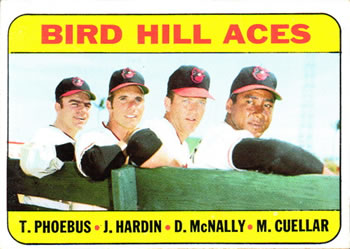
He and Wally Bunker were not only the 2 youngest pitchers on the 10-man staff, but also made the least amount of appearances as they swung back and forth between 5th starter and occasional reliever. (The O’s had Dave McNally, Jim Hardin, and Tom Phoebus at the front of their rotation, with Gene Brabender and Dave Leonard as the primary swingmen filling the 4th starter’s slot. Eddie Watt, Moe Drabowsky, and Pete Richert were the 3 primary relievers, so there wasn’t much for Nelson or Bunker to do.) 
 
Left unprotected in the October 1968 expansion draft, Nelson was selected by the Royals (as was his O’s teammate Bunker). Together they headed up the starting rotation for the new Royals team. (Nelson made 29 starts, and was the only one of the 16 pitchers used by KC that season who made no relief appearances.) 
 
Injuries limited him to 4 games in 1970 and 13 games in 1971. He returned to full-time duty in 1972, making 19 starts (3rd on the team) and 15 relief appearances while posting a 11-6 record and a 2.08 ERA. 
 
In November 1972 he was traded to the Reds (with outfielder Richie Scheinblum) for pitcher Wayne Simpson and outfielder Hal McRae. Roger pitched for the Reds for 2 seasons, appearing in 14 games each year as a small cog in the Big Red Machine. 
 
Nelson was sold back to the White Sox after the 1974 season, but he was released during spring training the following year. The Athletics took a flyer on him, but after 20 games with their AA team, he was released in early-August.
 
The Royals picked him up in April 1976, and he played most of ’76 and all of ’77 with their AAA team, making his final 3 MLB appearances with Kansas City in September 1976. 
 
Roger played for the Pirates’ AAA team in 1978, and in Mexico in 1979 before retiring. 
 

Thursday, September 12, 2019

Doug Rader (#355)

This is Doug Rader’s 3rd solo card, but anyone familiar with vintage Topps cards will know that the '68 and '69 Astros cards are not much to look at.  Rader also appeared on an Astros Rookies card in 1967.

Rader was signed by the Astros before the 1965 season. After just 2 ½ seasons, he made his major-league debut in July 1967.

He played a bit at 3rd base, but was mostly used at 1st base during his rookie season, starting 33 games there during the 2nd half. (In early-August, the Astros traded veteran Eddie Mathews to the Tigers, opening up 1st base for Rader.)


Rader was back on the bench at the start of 1968, but with long-time regular (and original Colt .45) Bob Aspromonte out of the lineup for a month beginning in mid-June, Doug began a streak of 32 starts at 3rd base. Even after Aspro’s return, Rader played most of the time.

Aspromonte was traded away after the ’68 season, so Rader was the full-time 3rd baseman, starting almost every game until early-September 1975.

Doug also won the Gold Glove award every season from 1970 to 1974.

In December 1975 he was traded to the Padres for pitchers Larry Hardy and Joe McIntosh. He started 136 games at the hot corner in 1976, an improvement over the 7-man committee playing there in 1975. 

He started 47 of the first 55 games in 1977, then was sold to the expansion Blue Jays in early-June.

Rader played 96 games with Toronto that year, split between 3B and DH. He was released during spring training in 1978.

After his playing career he became a manager. He coached for the Padres in 1979, then managed their AAA team from 1980-82. He also managed the Rangers (1983-85), White Sox (1986), Angels (1989-91), and Marlins (1993-94).

Sunday, July 14, 2019

Dave Campbell (#639)

About 5 years ago (wow, has it been that long?) a blog reader sent me four cards from my 1970 want list in exchange for a handful of 1968 Topps playing cards. Those cards were Dave Leonhard, Dalton Jones, Bob Allison, and Dave Campbell (all high numbers). 

Dave Campbell (whose nickname is "Soup") was a utility infielder who played for the Tigers and Padres, but he did have 2 seasons (1970-71) as a regular for the Padres.

Campbell was signed by the Tigers in 1964, and played in their farm system for several years, initially as a first baseman until switching to 2nd base in 1966. He made his major-league debut with 2 games in September 1967.


Campbell returned to the minors the following season, except for a 9-game stint with Detroit in June.

In 1969 he played 32 games for the Tigers, spread across the entire season, although it appears he was back in the minors for much of mid-May to mid-July.

In December 1969 Dave was traded to the Padres (with pitcher Pat Dobson) for pitcher Joe Niekro. This was Campbell’s big break, as he was San Diego’s regular 2nd baseman in 1970, replacing 1969’s trio of Jose Arcia, John Sipin, and Roberto Pena. Dave reached career-highs in games (154), at-bats (581), runs (71), hits (127), doubles (28), homers (12), and RBI (40). The only blemish was his paltry .219 batting average.

In 1971 the Padres acquired 2nd baseman Don Mason from the Giants, so Campbell alternated between 2B (with Mason) and 3B (with Ed Spiezio). In late-May Gary Jestadt was acquired from the Cubs, and joined the 2B/3B mix. Campbell started 68 games at 2B and 31 at 3B. By late-August, the team had settled on Mason at 2B and Jestadt at 3B, so Campbell rarely played after that.

Dave started 30 of the first 35 games at 3rd base in 1972, but then Jestadt reclaimed the job, and Campbell was shipped off to the Cardinals. He played sparingly for St. Louis, and in August was traded to the Astros for outfielder Tommie Agee.

He played 9 games for Houston in 1973, and 35 games in 1974. In his final season he was used mostly as a pinch-hitter or pinch-runner.

In the late-1970s he started doing play-by-play for the Padres. This led to a 20-year career at ESPN (1990-2010).

Friday, May 24, 2019

Bill Stoneman (#398)

In just his 3rd big-league season,  Bill Stoneman became the first big star for the expansion Montreal Expos pitching staff.

Stoneman was signed by the Cubs in June 1966, and after two half-seasons in the minors, he made his major-league debut in July 1967. (Stoneman was so fresh that Topps didn't even have him on a Cubs' Rookies card in the 1967 set.) He pitched 63 innings over 28 games for the remainder of the season, picking up 4 saves.

In 1968 he only played 18 games for the Cubs, while pitching 6 games in triple-A. That doesn't add up to a full season, so maybe he spent time on the DL. After that season Bill was left unprotected in the expansion draft, and was selected by the Expos with the 19th pick.


He began 1969 as the #2 starter behind veteran Mudcat Grant, and in only his 5th start he pitched a no-hitter against the Phillies. By early-June, Grant was dispatched to the Cardinals while Stoneman became the team's ace, leading the staff with 36 starts (9 more than the next guy), 235 innings (56 more than the next guy), and 185 strikeouts (52 more than the next guy).   His 11 wins made him the only Expo hurler with double-digit wins (although he also lost 19 games).

Stoneman had an off-year in 1970, but teammate Carl Morton had an even better season than Bill's 1969,  winning 18 games and the NL Rookie of the Year award.

Stoneman bounced back to lead the staff in '71 and '72. In both seasons he led the team in starts, innings, and strikeouts, with half of his 1971 starts being complete games (19). He also had 13 complete games in 1972, tying him with newcomer Mike Torrez. Bill made his only All-Star team in 1972, and also pitched his 2nd no-hitter in his final game that season (Oct 2nd).

The wheels came off in 1973, as he only started 17 games while his ERA ballooned to 6.80 and only struck out 48 batters. By August he was replaced in the rotation by Steve Rogers, who would finish 2nd in the NL Rookie of the Year voting.

Stoneman was sold to the Angels the day before the 1974 season opener, but by the end of June his record was 1-8 with a 6.14 ERA. He was released 2 weeks later, ending his career.

He began working in the Expos' front office in 1983, and was eventually named their GM. Stoneman was also the Angels' General Manager from 1999-2007.

Thursday, April 18, 2019

Jimmie Price (#129)

Jimmie Price was the Tigers' backup catcher from 1967-1971. (Backing up Bill Freehan meant you didn't get much playing time.) 

Price was signed by the Pirates in 1960, and played in their farm system for 7 seasons (the last 3 at triple-A). Four days before the 1967 season, he was purchased by the Tigers (after already appearing on a 2nd-series Pirates Rookies card that year).


Jim spent 5 seasons as the Tigers' #2 catcher behind Freehan. His most playing time came in 1969, when he had career-highs in games (72), starts (49), complete games (44), and at-bats (192). Price also had 2 at-bats in the 1968 World Series.

The Tigers acquired Tom Haller from the Dodgers in December 1971 to back up Freehan in '72, spelling the end of Price’s career.

Jim has been broadcasting Tigers' games since the 1970s.

Sunday, December 23, 2018

Gary Waslewski (#607)

Gary Waslewski pitched for 5 teams in his short 6-year career.

He was signed by the Pirates in 1960, and eventually dealt to the Red Sox in 1964. Gary made his major-league debut with the AL champion Red Sox in June 1967, and also started game 6 of the World Series.


After 46 games in 2 years with Boston, he was traded to the NL Champion Cardinals after the 1968 season for shortstop Dick Schofield.

His good fortune didn’t last long, as he was flipped to the expansion Expos in June for pitcher Jim Grant. Gary started 14 of his 30 games for the Expos, and was 5th in innings pitched for a team using 18 pitchers in its inaugural season.

The following May, it was on to the Yankees. Waslewski pitched more games for the New York (50) than with any other team. The Yankees releases him near the end of Spring Training in 1972, and he was picked up by the Athletics in mid-May.

He only pitched 8 games for the A’s that season, spending most of the year in AAA ball. Gary pitched in triple-A for the Athletics (1973) and Red Sox (1974) before retiring.

Saturday, March 24, 2018

Final Card: Cisco Carlos

Cisco Carlos (#487) had a brief 4-year career for the White Sox (1967-69) and Senators (1969-70). This is his final Topps card. He previously appeared on a White Sox Rookies card in the 1968 set, and had his own card in the 1969 set. Since this ’70 card is a capless mess, I am also going to post his 1969 card below.

Carlos pitched in the 1960 College World Series with the University of Northern Colorado, then was signed by the White Sox before the 1961 season. He worked his way up their organizational ladder, finally spending 3 full seasons in double-A ball (1964-66).


Cisco began the 1967 season with the White Sox' AAA team, and made his major-league debut with the Sox in late-August 1967. He won 2 games in the final weeks of the ’67 season as the Sox tried to keep pace with the Red Sox and 2 other teams.

Carlos returned for a full season in Chicago in 1968 (the only year he was not also in the minors). He had been primarily a starting pitcher in the minors and majors through the 1968 season, but after a 4-14 record in 1968, Carlos was relegated to the bullpen the following season.


He began the 1969 season with 6 games for Chicago’s AAA team, then pitched 25 games for the Sox between late-May and mid-August. On August 25th he was sold to the Senators.

Carlos pitched 6 games for the Nats in September 1969 (starting 4), then was in the minors for all of 1970 until he was recalled in September, and played his final 5 big-league games.

He kicked around in the minors from 1971-73 (with his final season in the Astros’ organization) before retiring.

Tuesday, January 3, 2017

Rickey Clark (#586)

Rickey Clark was a teammate of previous blog subject Marty Pattin with the 1968 Angels. Despite Clark's contributions to the 1967 Angels, this is his first Topps card.

Clark was signed by the Tigers in 1965, and after 2 seasons in the minors, he was selected by the Angels in the Rule 5 draft. This means automatically making the team the following season. Not only did he make the team in '67, he was their #3 starter as a 21-year-old rookie, compiling a 12-11 record in 32 games (30 starts).


Unfortunately, his first season was his best season. In 1968 he crashed and burned with a record of 1-11 in 21 games, only pitching half the innings he did as a rookie. Clark spent most of 1969 and all of 1970 in the minors.

He returned to the Angels for part of 1971 (11 games over the 2nd half of the season). His final big-league season was 1972, appearing in 26 games for the Angels, while staying out of the minors for the first time since 1968.

The Phillies purchased his contract in January 1973, and he played 29 games for their AAA team before retiring.

Sunday, October 23, 2016

Wayne Comer (#323)

Here is the only card of Wayne Comer pictured in a Seattle Pilots uniform. I read Jim Bouton’s book “Ball Four” during the summer of 1971, and I recall that Comer was one of the players Bouton definitely did not get along with. Wayne’s rookie card is a capless job in the 1969 set.


Comer was signed by the Senators in 1962 (I learned something new today, previously thinking he started with the Tigers). After 1 season in the minors he was traded to the Tigers for 1st baseman Bobo Osborne.

Wayne played in the Tigers’ farm system from 1963-68, also playing 4 games with Detroit in September 1967 and 48 games in 1968 after his late-May recall. In 1968 he was used as a pinch-hitter and left field backup, only making 4 starts that season. (Let’s face it, when your team has Al Kaline, Willie Horton, Jim Northrup, and Mickey Stanley ahead of you in the outfield, you are not going to play much.) Wayne did get 1 at-bat in the 1968 World Series.

Comer was selected by the expansion Seattle Pilots after the 1968 season, and was their #1 outfielder in 1969, playing in 139 games including 85 starts in center field and 40 starts in right field. His 15 home runs were 2nd on the team behind Don Mincher’s 25 dingers.

Wayne lost a starting outfield spot to the newly-acquired Russ Snyder at the start of the 1970 season, and after only playing 13 games (2 starts) he was traded to the Senators in mid-May for outfielder Hank Allen and 2nd baseman Ron Theobald. He played in 77 games for the Sens that season, as a pinch-hitter and 6th outfielder.

After the 1970 season the Tigers purchased his contract, but Comer played all of ’71, most of ’72, and all of ‘73 with Detroit’s AAA team in Toledo. He also played 27 games in the middle of the 1972 season, mostly as a pinch-runner and pinch-hitter (no starts).

Comer’s career ended after the 1974 season, where he played for the Phillies’ double-A team in Reading, PA. Looking back, Wayne’s best season was 1969 with the Pilots.

Friday, September 5, 2014

Dave Leonhard (#674)

A few months ago, I offered up some 1968 Topps Playing Card inserts in trade for something on my want list (which is mostly made up of 1966 and 1970 high numbers). 

To date I have had one response, from blog reader Dave of Middletown, MD. Dave sent me four 1970 high-numbered cards in excellent condition, in return for a handful of 1968 playing cards. Here is the first of those four cards.


Dave Leonhard had a six-year career (all with the Orioles) from 1967 to 1972. I consider him to be in the “2nd tier” of Orioles’ starters of that era (along with Tom Phoebus and Jim Hardin), behind the “1st tier” of Jim Palmer, Dave McNally, Mike Cuellar, and even Steve Barber. (Let’s make Wally Bunker tier 1-A, losing points for lack of longevity.)


Leonhard was signed by the Orioles in 1963, and played 5 seasons in the minors. After winning the International League Pitcher of the Year award in 1967, he made his major-league debut in September.

Dave was a starter in the minors, and also during the 1968 season when the O’s were short on quality starters. (Palmer missed all of 1968 with a sore arm, Bunker was ineffective, and Cuellar had not yet arrived from Houston.)

With the return of Palmer and the acquisition of Cuellar for 1969, Dave was relegated to the bullpen, where he remained for the next 4 seasons. After pitching 94 innings over 37 games (3 starts) in 1969, Leonhard was limited to just 28 innings (over 23 games) in 1970, compiling a 0-0 record with a 5.08 ERA, and was rarely used during the second half.

That bought him a trip back to the minors in 1971, where he was once again used as a starter. Dave didn’t return to Baltimore until July 10th, and played in only 10 games for the Orioles that year.

In 1972 he played in only 14 games. His games were scattered throughout the season, and he didn’t play in the minors that year. It seems like he either spent a lot of time on the DL, or the last seat in the bullpen.

Dave’s final big-league game was on September 20, 1972. In June 1973 he was traded to the Angels for utility man Jim Hutto. Over the next 4 years, Dave bounced around from the Angels to the Cubs to the Expos, playing in AAA in ’73 and ’74, and in AA in ’75 and ’76.

Wednesday, August 20, 2014

Ray Fosse (#184)

Ray Fosse caught for the Indians, Athletics, and others from 1967 to 1980, but is most remembered for being run over at home plate by Pete Rose on the final play of the 1970 All-star game.

Fosse was drafted by the Indians with the 7th overall pick in the first-ever 1965 amateur draft (6 picks behind Rick Monday and 29 picks ahead of Johnny Bench).

After a few cups of joe in ’67 and ’68, Ray made the Indians in 1969, playing 26 games in the first 2 months, before shipping out to AAA in mid-June. He returned in September to start 11 games in the final weeks.

In 1970 Ray took over the starting catching duties from the departed Joe Azcue, starting 120 of the first 136 games, but did not play after September 3rd. Fosse made the all-star team as a rookie, and despite being bulldozed by Charlie Hustle, Ray hit .307 for the season, with 18 homers and a Gold Glove award.


In 1971 he started 119 games behind the plate, but various injuries caused him to miss the last 3 weeks in July (including the all-star game). However, he won his 2nd Gold Glove award and hit .276.

1972 was Fosse’s last season with the Tribe. He was the #1 catcher again, starting 121 games behind the dish, but his offensive production fell off from his first 2 seasons.

After the season, he was traded to Oakland for catcher Dave Duncan and outfielder George Hendrick. Ray played for the Athletics for 3 seasons. He was the starter in ’73, shared the position with Gene Tenace in ’74, and was Tenace’s backup in ’75. Ray did appear in the post-season each year with the A’s (something he had no chance for with Cleveland back then).

After the 1975 season, Ray was sold back to the Indians, where he shared the starting catching duties with Alan Ashby (in ’76) and Fred Kendall (in ’77). In September 1977, he was traded to the expansion Mariners for pitcher Bill Laxton.

Fosse became a free agent after the 1977 season, and signed with the Brewers, but was injured during spring training and missed the entire 1978 season. He played sparingly in 1979, and was released during spring training in 1980.

Since 1986 he has been a broadcaster for the Athletics.


(With this post, every team is now represented at least once.)

Wednesday, September 19, 2012

Terry Harmon (#486)

Terry Harmon was the Phillies' good-field/no-hit backup infielder from 1969-1977. (He also made a few pinch-running appearances in 1967.) This is Harmon's first solo card. In the 1969 set, he appeared on one of the last-series "National League Rookies cards.

As far as I know, Harmon is one of only 3 players to have played their entire career (of at least 10 seasons) with the Phillies (along with Mike Schmidt and Larry Christenson). Jimmy Rollins will join that group, unless he gets off-loaded to another team in the next few years.


Harmon was signed by he Phillies in 1965, and played in the minors during the 1966-68 seasons. Terry was called up to the Phillies for a few games in mid-1967 while Johnny Briggs was on the DL, and appeared only as a pinch-runner. It appears he was "loaned out" to the Buffalo Bisons in the Washington Senators' organization for the 1968 season.

During his rookie season in 1969, Harmon started 36 games at shortstop for the Phillies, including all 24 games between June 13th and July 4th, in place of regular SS Don Money. Terry also started 12 games at 2nd base and saw action in another few dozen games.

In 1970, hotshot rookies Larry Bowa (SS) and Denny Doyle (2B) joined the team, further cementing Harmon's status as a backup. Still, he started 18 games at short and 10 at 2nd base.

Terry caught a break in 1971, as Doyle only played in 95 games, enabling Harmon to start 49 games in his place. 1972 was more of the same, with Terry starting 41 games at 2B along with 5 at shortstop.

With Cesar Tovar (and Billy Grabarkiewitz in mid-season) joining the Phils in 1973, both Harmon and Doyle had their playing time cut back at 2nd base, although Harmon was still the #2 man behind Doyle. Over at shortstop, rookie Craig Robinson took most of the starts that Bowa didn't make.

Terry played four more seasons with the Phillies, but with his starts cut way back. Dave Cash was the team's regular 2nd baseman from 1974-76, making a backup all but unnecessary. Harmon retired after the 1977 season.

Sunday, January 22, 2012

Clarence Gaston (#604)

This is the first "full" card for Clarence "Cito" Gaston. He previously appeared on a 1969 Padres Rookies card. Topps didn't begin referring to him as Cito until he became a manager.

Gaston was signed by the Braves in 1964 and spent 5 seasons playing in their minor-league system. His only big-league experience with the Braves was 9 games in September 1967.


Cito was the Padres' last (30th) pick in the October 1968 expansion draft. His minor-league days were now behind him, as Gaston made the Padres at the start of the season, and took over the starting center field job from Tony Gonzalez in game #4.

Cito's best season was 1970, when he hit 29 homeruns, batted .318, and was named to the all-star team. He was the team's regular center fielder for 3 seasons, then slid over to right field for 1972 and 1973. His final season with the Padres was 1974, which he spent as a pinch-hitter and part-time right fielder.

In November 1974 Cito was traded back to the Braves for pitcher Danny Frisella. He spent his last 4 seasons ('75-'78) as a pinch-hitter and outfield backup for Atlanta. On September 22, 1978 he was sold to the Pirates, and played 2 games for them before retiring after the season.

Gaston had greater success as a manager, piloting the Toronto Blue Jays from 1989 to 1997, and again from 2008 to 2010. His team finished in 1st place 5 times, including World Series championships in 1992 and 1993.

Monday, December 26, 2011

Reggie Jackson (#140)

Although 1970 would be Reggie Jackson's 4th year in the majors, this was only his 2nd card. Somehow, Topps failed to include Jax in the 1968 set (even on an "Athletics Rookie Stars" card). This despite being the 2nd overall pick in the 1966 draft, and spending the latter part of 1967 with the Kansas City Athletics. Not to worry though, our friend Steve at WhiteSoxCards has taken care of that problem.


Reggie was "the straw that stirred the drink" long before Darryl Strawberry arrived on the scene. He and Rick Monday were among the first wave of stars for the Oakland A's, and after a long career, he returned to Oakland for his 21st and final season as a DH, teaming up with Mark McGwire and Jose Canseco.